UNE EN ISO 19650-1: News and key concepts of the new ISO standard
This is just the beginning. The first standard in the ISO 19650 series on the standardization of the BIM methodology.
At the start of summer the Spanish version of UNE-EN ISO 19650-1 was published, the Spanish version of the ISO standard developed by the British Standards Institution (BSI) and published in English a few months earlier.
This standard is the first in a series that is being developed and is replacing the previous British standard and PAS 1192. The publication of this standard represents a move by the British institution to expand its influence and consolidate itself as the first BIM standard published with international scope.
This first chapter is titled: "UNE EN ISO 19650-1: Organization and digitization of information about buildings and civil engineering works, including building information modelling (BIM). Part 1: Concepts and Principles" and focuses, as its name suggests, on defining the basic concepts on which any project developed under the BIM methodology must be based. It provides a generic description of how processes should be and redefines many of the terms of the previous standard.
Next, we will look at some of these key concepts and how they may affect us.
It should also be noted that the second part of the standard has recently been published in Spanish (UNE EN ISO 19650-2: Organization and digitization of information about buildings and civil engineering works, including BIM. Part 2: Delivery phase of the assets) which until very recently could only be found in English and French versions.
Meanwhile, the CEN TC442 committee is developing parts 3 and 5 of this series, which will deal with the processes of use and management of information during the operational phase and information security requirements respectively, and are expected to be published in early 2020.
At my house we (no longer) play this way.
The difference with previous publications of standards is that this one, being developed as an ISO standard, is international in nature and has already been approved by the European Committee for Standardization. This means that this standard should serve as a base or reference for the development of possible national and European standards.
In some way, what this standard is trying to do is put an end to the current mix of regulations and references and the problems this causes when developing a BIM project. Without contradicting other usual reference documents (such as Penn State University guides, BIM Forum publications, etc.), this standard aims to establish at least the basic concepts and terminology that we should all use.
It therefore aims to clarify the steps to follow in managing digital information within a BIM process. It brings clarity to the current environment and ensures that no one can justify the different nomenclatures in documents by saying "that's how we play it at my house." Although the real rules of the game, those that help us work day to day, will have to be more local in nature and will come from future adaptations of the standard.
For example, alongside the publication of this standard, BSI also published the document PD 19650-0: UK Transition Guide, to help with the implementation of the standards and ensure that BIM Level 2 was achieved within this new framework.
BIM grows up: 5 key points by which the ISO 19650 standard expands the scope of the BIM methodology.
One of the most important conclusions one reaches after delving into this first chapter of the standard is that "BIM is growing up." This is at least what we can extract from the 5 key points we analyze below.
BIM Maturity.
The publication of an ISO standard finally consolidates the concept that BIM is here to stay, in case there was still anyone in doubt. This represents an advance at a technical level, but also at a strategic level where it is now difficult to justify that any progress in the sector does not involve integration within the BIM methodology.
Scalability.
In this case, we should say more than "BIM grows up" that BIM is also getting smaller. And one of the most notable points of the standard's principles is the one that contradicts that pseudo-slogan/justification that said "BIM is only for big projects."
BIM is for all types of projects. Thus the document's own introduction states that this standard "is applicable to built assets and construction projects of any size and level of complexity."
While it is obvious that not all projects are equal, and that the structure of these is determined by that size and level of complexity. That is why the concept of scalability is emphasized: "They must be applied proportionally and adapted to scale and complexity."
Currently its application in practically all mega-projects is already a reality. However, the benefits of applying the BIM methodology could be considered even higher proportionally in cases of "Little BIM," where it is easier to ensure control over its application. In any case, the team structure, requirements and objectives must be adapted to the characteristics of the project.
For everyone:
Another reason we consider BIM "grows" according to this standard are the roles and agents cited as recipients of the standard.
"The concepts and principles of this document are aimed at all those involved in the life cycle of assets. This includes, but is not limited to, the asset owner/operator, client, asset manager, design team, construction team, equipment manufacturer, technical specialist, regulator, investor or end user."
In other words, the cross-cutting nature of information management within a project is highlighted. This is especially important to make people understand that the BIM methodology, and the management of its associated information, has to be something that involves all the departments of companies, and is not something that can be kept isolated or in parallel. BIM models for example are containers of information where departments such as finance, legal or administration will also have to consult information related to their tasks.
Throughout the entire cycle:
Another concept that has been expanded in this standard is the application cycle.
Thus, in the main prerequisite document, the EIR (Exchange Information Requirements), it is specified that both the project information requirements (PIR-Project Information Requirements) and those referring to asset information (AIR-Asset Information Requirements) must have a place.
"This document applies to the entire life cycle of any built asset, including strategic planning, initial design, engineering, development, documentation and construction."
In addition, this renewed graphic is included, where the project development phase is located as a small part of information management compared to the operational phase, and emphasis is placed on the transition phases (A and C) where the transfer of information from the project carried out or to be carried out to the asset and vice versa takes place.
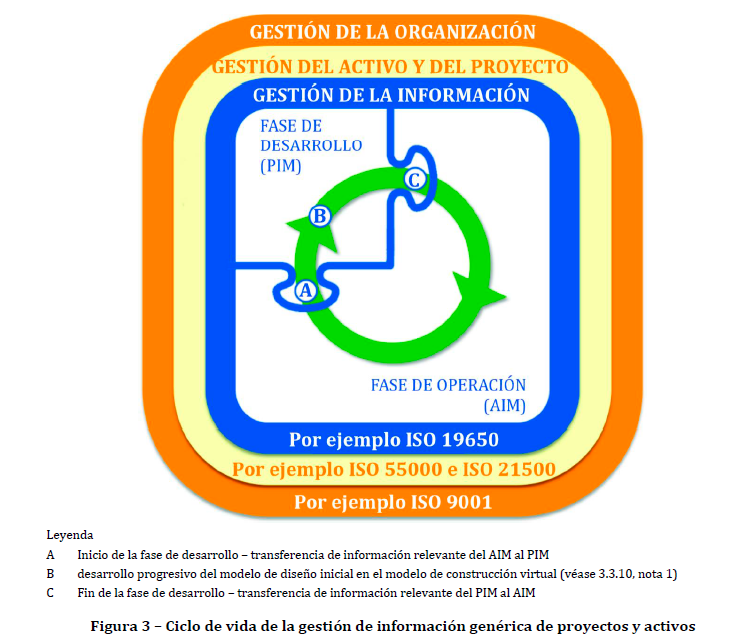
The transition phases A and C are key points of the process.
The first, A, would coincide in most cases with the development of the building project, where information about the asset is extracted if any (the building to be demolished, the plot, or the building on which to do a renovation, for example).
Part C corresponds to the entry of information from the project development phase to the building operation phase, which would coincide with the AsBuilt information and/or models.
It should be noted that the scalable nature of this cycle is highlighted, which would apply to any intervention on an asset in any state in which it is found.
- All information:
It is not a new concept, since both the title of the standard "Organization and digitization of information(...)" and in the very acronym of BIM, information appears as the key to the entire process_._
The truth is that the management of this information becomes the main aspect of the standard again, and its structuring within the CDE (Common Data Environment) is one of the pillars on which PAS 1192 was already based, and this ISO 19650 Standard continues to base.
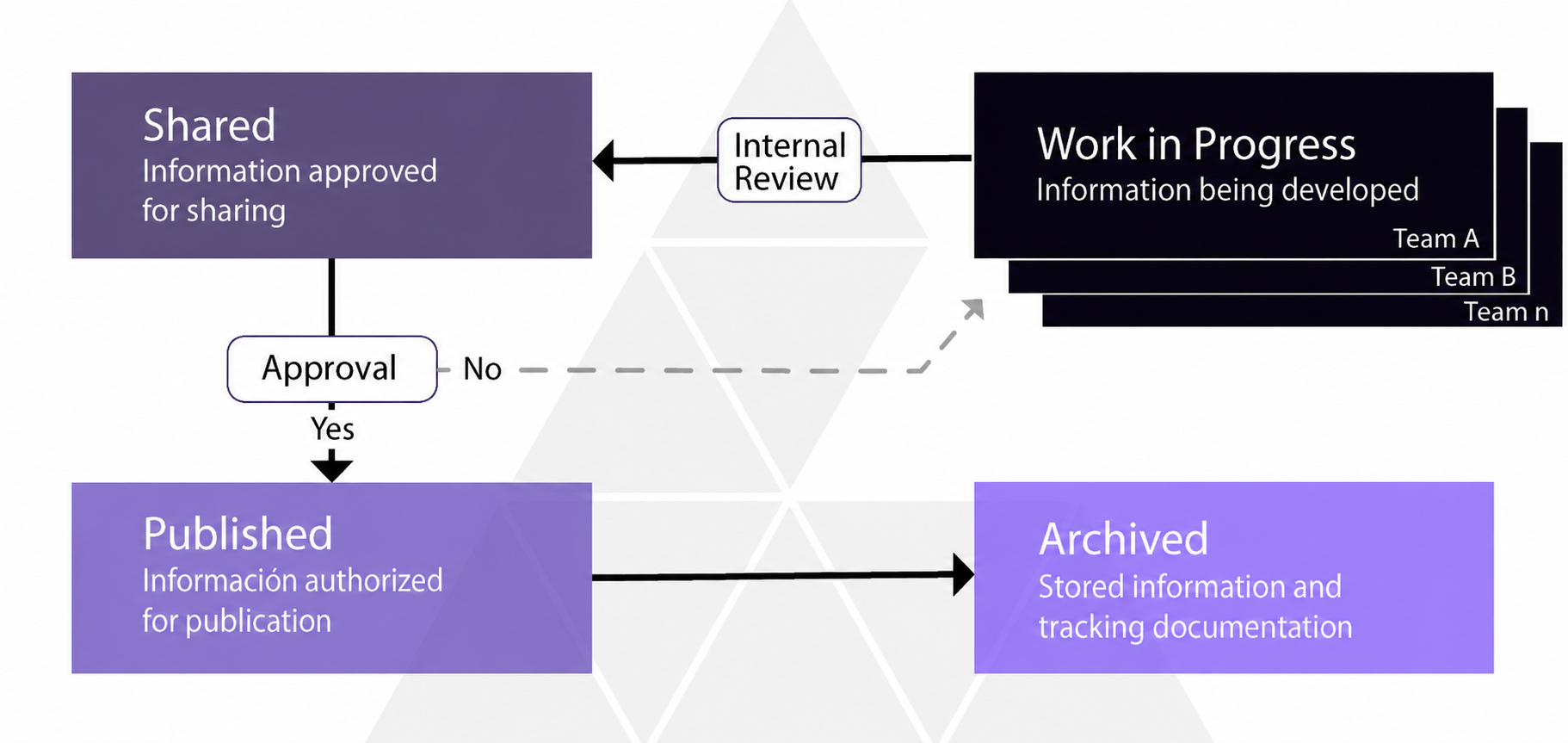
What we have found novel and very interesting regarding information is the introduction of a key concept: information granularity.
This concept of granularity emphasizes the fact that the information provided must be the minimum necessary to satisfy each requirement. That is, more information than necessary will not help in the development of what is proposed but will instead hinder the correct use of what is necessary.
In turn, its importance is even highlighted by stating: "The granularity of alphanumeric information should be considered at least as important as that of geometric information."
Therefore, in the level of definition and/or development of the information it must always be subordinated to the achievement of the proposed objectives.
We can conclude then that for BIM development, the most important thing will be:
The right information, in the right place, at the right time.
Finally, in relation to information management, an outline is introduced as a perspective on the maturity stages in the management of analog and digital information. We consider this to be a broad and very interesting topic which has motivated the following post:
"Perspective on the maturity stages: A detailed view of what the ISO-19650 standard proposes."