Laser scanning of large industrial complexes, part 1.
1- “Scan to BIM: beyond teamwork”
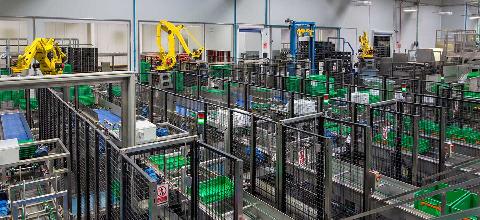
The challenge was to scan a logistics center the size of 15 football fields in the shortest time possible.
Yes, you read correctly, there were more than 100,000 m2 in 20 days... a whole deployment of means to provide a complete solution to our client: A massive data collection to develop the digital twin of the building. And for what? Well, to obtain a current state of the building, and to save time and money.
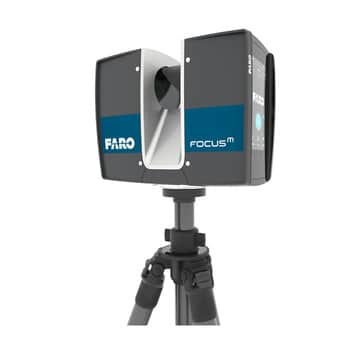
Let's start at the beginning: our 3D laser scanner is a Faro M70, which captures color points within a 70 meter radius, in a matter of minutes.
In addition, it takes 360º digital photographs of the building in each shot. The resulting 3D point cloud is a set of millions of coordinates (x,y,z), positioned in space and in true magnitude, which faithfully and accurately represent reality.
Planning and strategy:
An industrial building of this size, and fully operational, requires very detailed prior planning and a team of operators experienced in data capture and processing: the team of operators who have taken data and subsequently recorded the information has been made up of 6 BIM technicians. To give you an idea, each of them walked between 5-7 km a day through the industrial complex.
The scanning and study strategy of the project was carried out during the month prior to data collection, integrating work sessions as a real example. To meet the demanding time schedule that required us to perform more than 100 scans a day, we carried out a pull session. Some of the conclusions we obtained and that we share with you here:
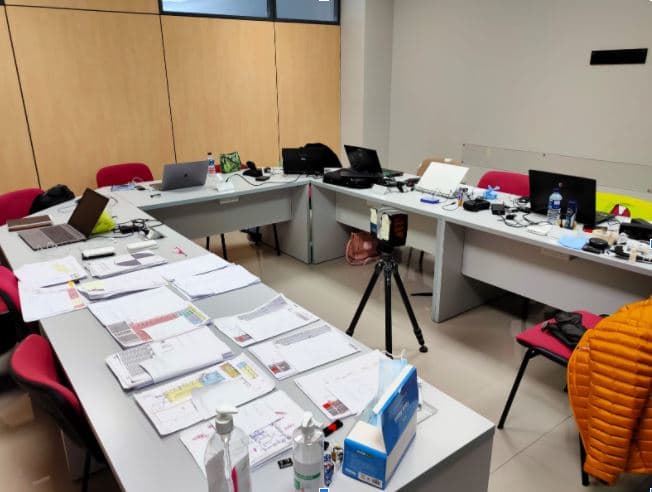
- Review Health and Safety principles daily: the building is operational.
- Have plans as a sketch for taking positions in the field.
- Establish a file naming standard: the control and verification of each of the scans in the field is essential for the management of the information we are generating.
- Previously generate the scanner profiles adjusted and prepared for field work.
- Spheres: (THE KEY): Spheres printed on our 3D printer with different types of grip (suction cups, magnets and bases). We will tell you more about them in the second part of this series.
- Deploy the necessary means: 6 computers, 2 scanners, 1 drone...
- Really work as a team.
Conclusion:
Taking big data in an agile and fast way makes sense if, later, we can use that data for a deeper use or purpose. When you are faced with more than 100,000 m2, obtaining an optimal point cloud in size and detail is essential, without going overboard, but without falling short.
Subdivide the project and plan with an initial strategy that standardizes teamwork, much of the success comes from here.
In the following posts we will tell you more about our "Scan to BIM" experience, about the spheres, the tricks for treating the large point cloud, the processing software, etc.
Spread the word!