ISO 19650 Explained: The 6 Parts and Key Requirements
ISO 19650 is the international series of standards that sets out the principles and processes for managing information throughout the entire lifecycle of a built asset using BIM. Its purpose is to ensure that every participant has access to the right information, at the right time and within an organised collaborative environment.
The ISO 19650 series does not prescribe which BIM software must be used or how a building should be modelled. Instead, it defines how project information and documents should be organised, produced, reviewed, exchanged and retained, from planning and design through construction, operation, maintenance and the end of the asset's lifecycle.
In this guide, we explain what ISO 19650 is, the parts that make up the series, its main concepts and how it can be applied to BIM projects.
What is ISO 19650?
ISO 19650 is a series of international standards for information management using BIM. It provides a common framework that enables clients, asset owners, designers, contractors, engineering firms, asset managers and other participants to work according to shared processes and criteria.
Its purpose is to improve the production and exchange of information, reduce errors and duplication, and ensure that every team receives the information it needs at the appropriate time.
The standard can be applied to:
- Buildings and infrastructure.
- Projects of any size and level of complexity.
- New and existing assets.
- Design, construction, operation, maintenance and end-of-life phases.
- Public and private organisations.
- Project teams involving one or several companies.
ISO 19650 focuses on information management: it does not require the use of any specific BIM software.
The series is based on principles previously developed in the British standards BS 1192 and PAS 1192, but establishes an international framework that can be applied to organisations and projects in different countries.
Up-to-date information about the series can be found on the
official ISO Building Information Modelling page
What is ISO 19650 used for?
ISO 19650 is used to organise the management of information associated with a project or asset developed using BIM. It establishes a framework for defining what information is required, who must produce it, when it must be delivered and how it should be reviewed, authorised and shared.
Applying the standard helps project participants work according to coordinated criteria and avoids each organisation using incompatible procedures, structures and naming conventions.
Its main objectives include:
- Clearly defining the responsibilities of each participant.
- Establishing information requirements from the beginning.
- Planning the production and delivery of information.
- Organising the review, authorisation and acceptance of documents and models.
- Reducing errors, duplication and information loss.
- Improving collaboration between clients, designers, contractors and asset managers.
- Maintaining traceability across BIM documents and models.
- Supporting the transfer of information between different asset lifecycle phases.
- Ensuring that the information produced responds to a specific requirement.
- Avoiding the unnecessary production of information.
Applying ISO 19650 is not simply a matter of using BIM. It means establishing an organised process for managing all the information associated with an asset.
What are the different parts of ISO 19650?
The ISO 19650 series consists of several parts. Each part addresses a particular phase or aspect of information management using BIM.
ISO 19650-1: concepts and principles
ISO 19650-1 establishes the general concepts and principles for managing information throughout the lifecycle of a built asset.
This first part introduces the foundations required to understand the rest of the series:
- Information management using BIM.
- The information lifecycle.
- Project and asset information models.
- Information requirements.
- The Common Data Environment.
- Participant responsibilities.
- Collaborative production of information.
- Level of Information Need.
ISO 19650-1 applies generally across all asset lifecycle phases and provides the conceptual framework for the other parts.
You can find more information in our article about the
ISO 19650-2: delivery phase of the assets
ISO 19650-2 develops the information management process for the delivery phase of an asset. This phase normally includes design, tendering, appointment and construction.
This part describes activities such as:
- Assessing information needs.
- Defining Exchange Information Requirements.
- Preparing the invitation to tender.
- Evaluating the capabilities of prospective delivery teams.
- Preparing and confirming the BIM Execution Plan.
- Mobilising resources and information systems.
- Producing information collaboratively.
- Reviewing and authorising models and documents.
- Delivering the information model at the end of the phase.
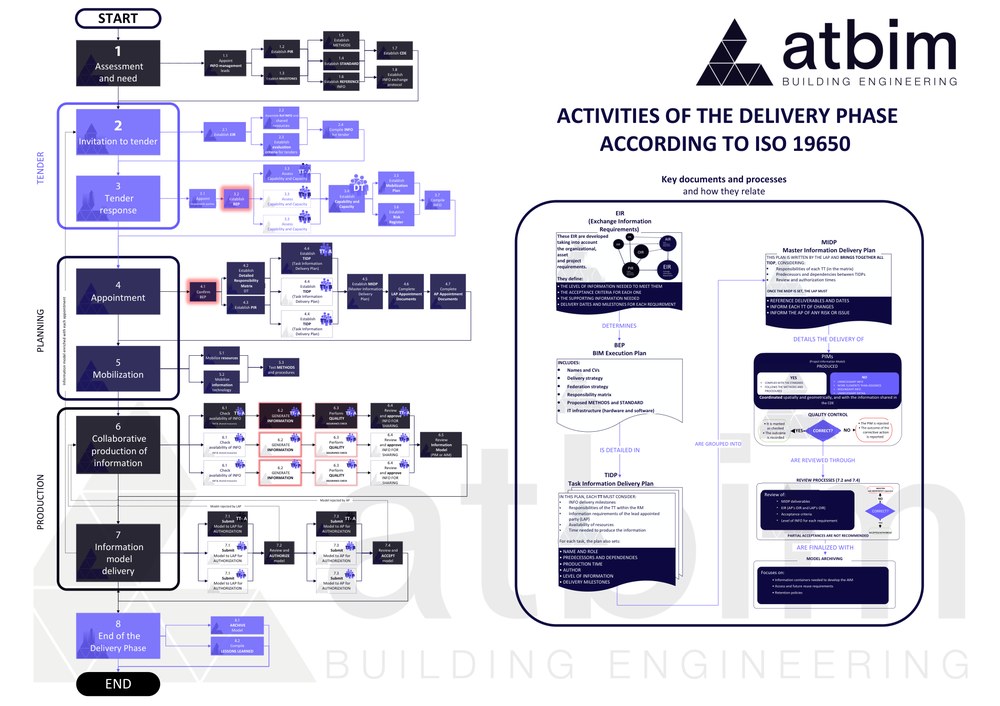
ATBIM diagram showing the activities, documents and information management processes involved in the delivery phase.
ATBIM has produced a visual resource to help explain this process. You can visit our page to
download the ISO 19650-2 summary diagram in PDF
The ATBIM document is an original explanatory diagram available in Spanish. It is not a copy of, and does not replace, the official standard.
ISO 19650-3: operational phase of the assets
ISO 19650-3 focuses on information management during the operational phase of an asset.
It helps organise the information needed to manage a building or infrastructure once it is in use. This includes both planned activities and events that may generate new information requirements.
Examples include:
- Maintenance operations.
- Inspections and audits.
- Refurbishments or extensions.
- Equipment replacement.
- Changes in the use of the asset.
- Incident management.
- Asset performance assessment.
- Transfer of information to asset management systems.
This part is particularly important for connecting BIM with asset management, maintenance and digital twins.
ISO 19650-4: information exchange
ISO 19650-4 establishes criteria for information exchanges during the different phases of an asset's lifecycle.
Its purpose is to improve the quality of the exchange process and ensure that the information delivered:
- Responds to the established requirements.
- Has the correct structure.
- Can be understood by the receiving party.
- Can be reviewed and validated.
- Is suitable for its intended purpose.
- Is delivered at the agreed time.
Information exchange is not simply a matter of sending files. Each exchange should be planned, have defined acceptance criteria and respond to a particular project or asset requirement.
ISO 19650-5: security-minded approach to information management
ISO 19650-5 establishes a security-minded approach to the management of sensitive information.
BIM models can contain information about access points, building services, systems, spaces, critical assets and infrastructure. Inappropriate disclosure of this information can create risks for an organisation, a built asset or its users.
This part helps organisations to:
- Identify sensitive information.
- Assess the risks associated with its use.
- Define security responsibilities.
- Establish access controls.
- Manage storage and information exchange appropriately.
- Reduce unnecessary exposure of information.
- Apply measures proportionate to the level of risk.
Security should be considered from the beginning of the information management process, rather than only after the models have been produced.
ISO 19650-6: health and safety information
ISO 19650-6 addresses the management of health and safety information throughout the lifecycle of built assets.
Its purpose is to integrate this information into BIM processes to support the identification, communication and management of risks.
This may include information related to:
- Risks identified during design.
- Construction risks.
- Maintenance operations.
- Access to hazardous areas.
- Materials or equipment requiring special precautions.
- Safety during operation.
- Future work on the asset.
This part reinforces the use of information as a tool for making safer decisions throughout every lifecycle phase.
Key ISO 19650 concepts
Several fundamental concepts must be understood before ISO 19650 can be applied effectively.
Information requirements
Information requirements define what information an organisation, project or asset needs and what that information will be used for.
The main types include:
- OIR — Organisational Information Requirements: information required to support the organisation's strategic objectives.
- AIR — Asset Information Requirements: information required to operate and manage an asset.
- PIR — Project Information Requirements: information required to support project-related decisions.
- EIR — Exchange Information Requirements: information requirements associated with a particular appointment or information exchange.
These requirements should be defined before models or documents are requested. This allows project teams to understand what must be delivered, at what level of information need, in which format and at what time.
Project and Asset Information Models
ISO 19650 distinguishes principally between:
- PIM — Project Information Model: used during the delivery phase.
- AIM — Asset Information Model: used during the operational phase.
Information models are not limited to three-dimensional models. They can also include documents, databases, drawings, specifications, photographs, records, properties and other information containers.
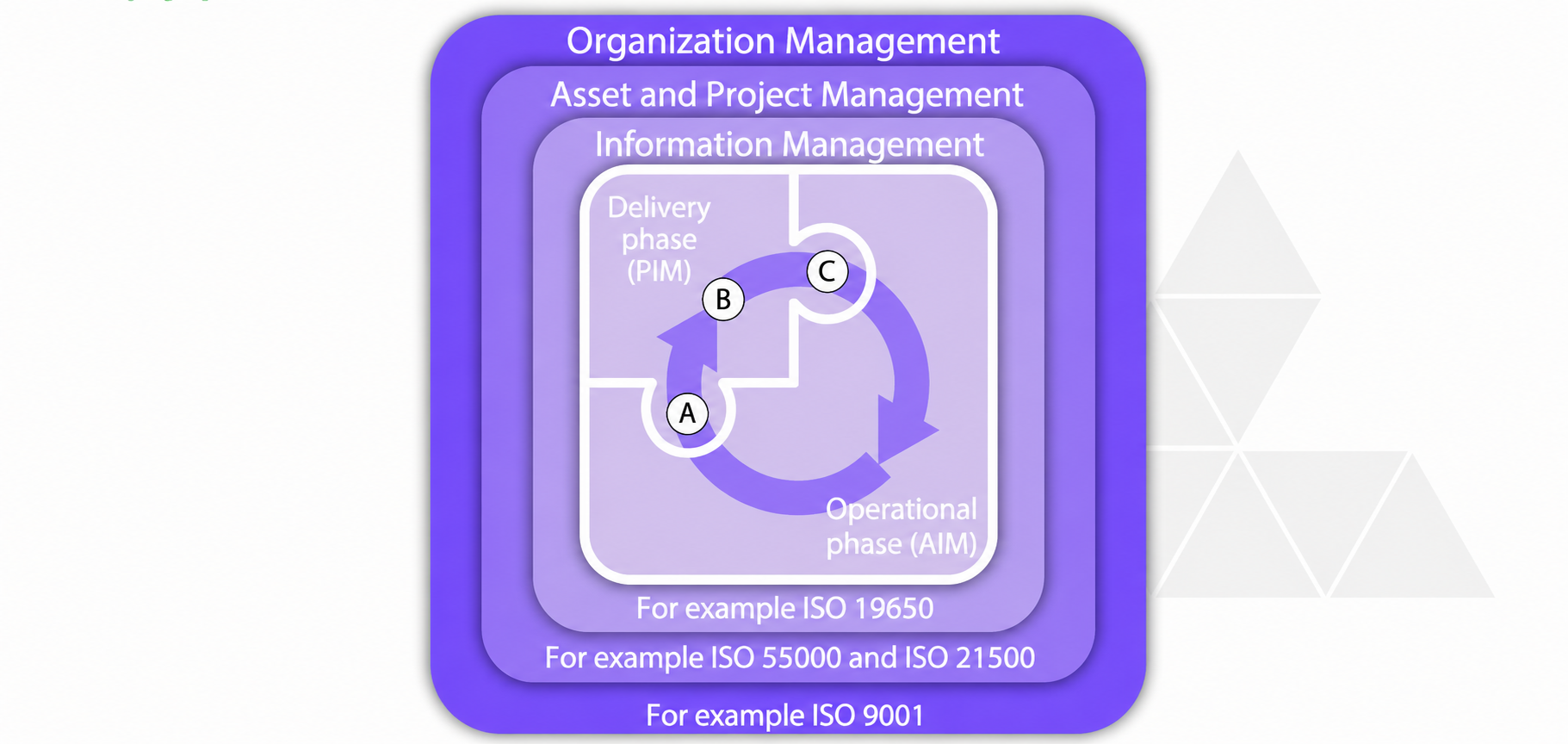
Relationship between the delivery phase —PIM— and operational phase —AIM— within the asset information management lifecycle.
BIM Execution Plan
The BEP, or BIM Execution Plan, explains how the delivery team intends to respond to the established information requirements.
It may include:
- BIM objectives and uses.
- Functions and responsibilities.
- Collaboration strategy.
- Information production methods and procedures.
- Model and file structure.
- Naming conventions.
- Systems and platforms.
- Review and coordination processes.
- Information delivery strategy.
- Team resources and capabilities.
The BEP should be adapted to the actual characteristics and requirements of the project. Using a generic document without adapting it to a particular project significantly reduces its value.
MIDP and TIDP
Information delivery is planned using documents such as:
- TIDP — Task Information Delivery Plan: the information delivery plan prepared by each task team.
- MIDP — Master Information Delivery Plan: the overall information delivery plan for the project.
These plans identify what information must be produced, who is responsible for it, when it must be delivered and which dependencies exist between teams.
Common Data Environment
The CDE, or Common Data Environment, is the agreed source of information used to manage and share information associated with a project or asset.
A CDE is not simply a shared folder in the cloud. It should support defined processes for controlling the status, review, authorisation, publication and archiving of information.
Information commonly moves through states such as:
- Work in Progress.
- Shared.
- Published or authorised.
- Archived.
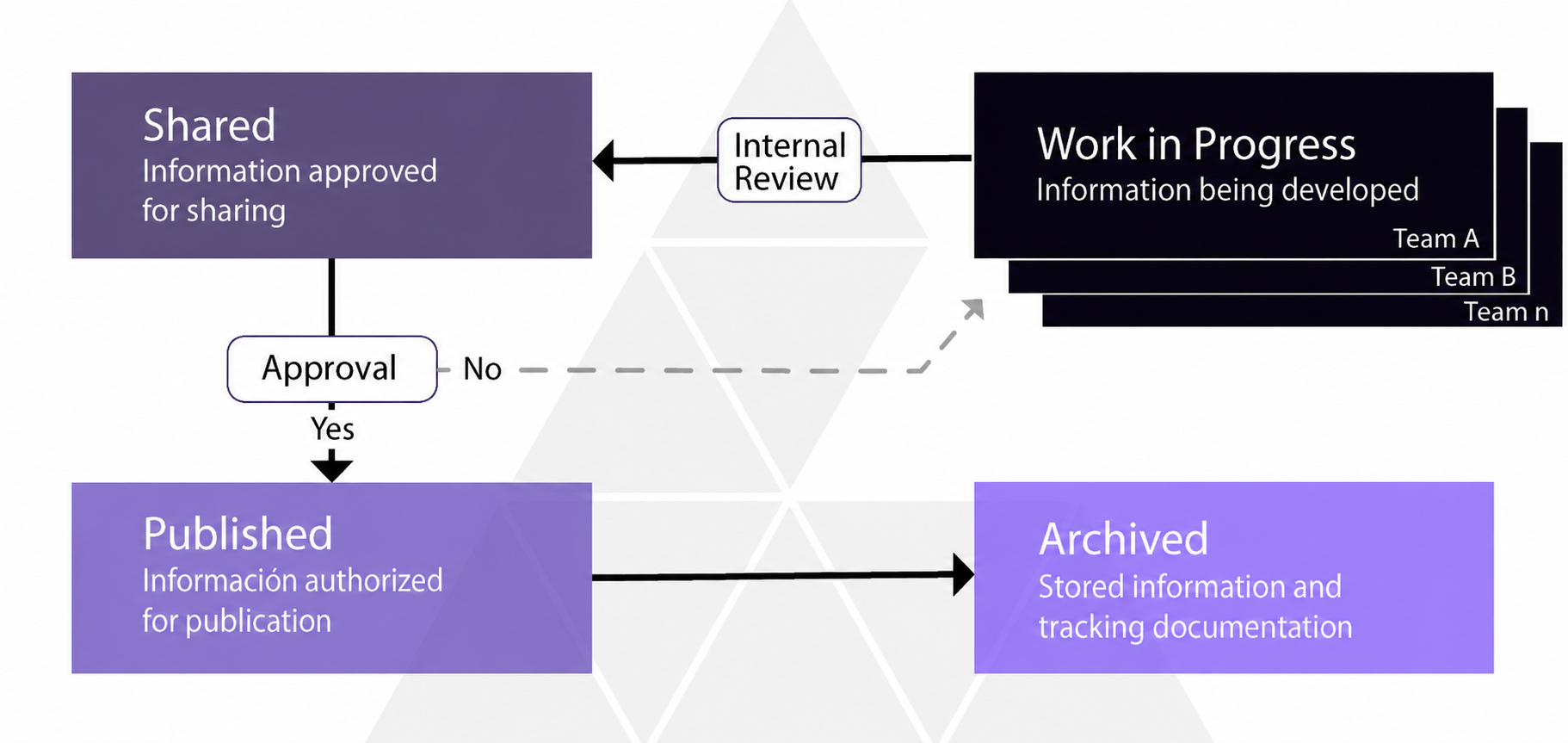
Simplified workflow between Work in Progress, Shared, Published and Archived information within a Common Data Environment.
The technology used should support the information management process. However, simply having a software platform does not in itself demonstrate compliance with ISO 19650.
Level of Information Need
Information should be produced at the level required to achieve a specific purpose. Adding more geometry, data or documentation than necessary does not always create value and can make information more difficult to manage and use.
Before producing information, teams should define:
- Why the information is required.
- Who will use it.
- When it must be available.
- What geometric information is required.
- What alphanumeric information is required.
- What documentation must accompany it.
This approach avoids confusing the quality of an information model with the indiscriminate accumulation of data.
Roles and responsibilities
ISO 19650 requires information management responsibilities to be clearly defined.
Each project should identify the organisations and teams that request, coordinate and produce information. Functions should be assigned according to contractual responsibilities, capabilities and the actual requirements of the project, rather than relying exclusively on generic job titles.
Information management is a shared responsibility and should not fall exclusively on one individual or on the modelling team.
How to apply ISO 19650 to a BIM project
Implementation should be adapted to the size, complexity, risks and objectives of the project. Not every project requires the same level of documentation or the same procedures.
A basic implementation process can be organised as follows:
- Identify the objectives of the organisation, project and asset.
- Define which decisions require information.
- Establish the information requirements.
- Assign functions and responsibilities.
- Assess the capabilities of the participating teams.
- Prepare the BIM Execution Plan.
- Configure the Common Data Environment.
- Define naming conventions, information states, reviews and authorisations.
- Plan information deliveries through the MIDP and TIDPs.
- Produce and coordinate information.
- Review every information exchange against previously defined criteria.
- Authorise and deliver the information.
- Maintain traceability and retain the necessary records.
- Transfer useful information between asset lifecycle phases.
- Review the process and implement improvements.
The application of ISO 19650 should be proportionate. A small project may use simpler procedures, provided that responsibilities, requirements and information deliveries are clearly defined.
Benefits of applying ISO 19650
Effective implementation can provide benefits such as:
- Greater clarity of responsibilities.
- Improved coordination between organisations and disciplines.
- Fewer errors and less rework.
- Reduced duplication of information.
- Greater traceability of decisions and information deliveries.
- Easier access to reliable information.
- Better control of versions and information states.
- Deliveries aligned with the client's actual requirements.
- A more organised transition between construction and operation.
- Greater security when handling sensitive information.
- More repeatable and scalable BIM processes.
- Better use of information throughout the entire asset lifecycle.
These benefits do not appear automatically because BIM software is being used. They depend on information requirements, responsibilities and processes being clearly defined and consistently applied.
ISO 19650 adoption and national standards
ISO 19650 provides an international information management framework, but it may be adopted under different national designations.
Within Europe, the standards may be published as EN ISO 19650, while individual national standards bodies may add their own prefixes or national annexes. In Spain, for example, the series is adopted as UNE-EN ISO 19650.
Practical implementation should also consider:
- Project and contractual requirements.
- Applicable national annexes.
- Local legislation and regulations.
- Agreed standards and classification systems.
- Client-specific information requirements.
- The BIM strategy of each organisation.
ISO 19650 provides the general framework, but each project must define how that framework will be applied in practice.
Is ISO 19650 mandatory?
ISO 19650 is not universally mandatory for every BIM project. Its application may be required by a contract, tender, public procurement process, client requirement or an organisation's internal procedures.
Even when it is not contractually required, it can be used as a reference for establishing consistent information management processes.
Does ISO 19650 require the use of BIM?
The series is intended for information management using BIM. However, it does not prescribe a specific tool or platform, nor does it define how individual elements must be modelled.
Its focus is on information requirements, processes, responsibilities and exchanges.
What is the difference between BIM and ISO 19650?
BIM is an approach to the collaborative creation and management of information about built assets.
ISO 19650 is a standardised framework that organises how that information should be managed: what is required, who produces it, how it is reviewed, where it is shared and when it is delivered.
Using BIM tools does not automatically mean that ISO 19650 is being applied.
What is the difference between ISO 19650-1 and ISO 19650-2?
ISO 19650-1 establishes the general concepts and principles. ISO 19650-2 develops the information management process for the delivery phase, which normally includes design and construction.
The first part provides the conceptual framework, while the second explains how that framework is applied during the delivery phase.
Does ISO 19650 require a CDE?
The Common Data Environment is a fundamental component of the information management process. The standard requires information to be managed within an agreed environment, but it does not require the use of a particular product or brand.
A CDE can be supported by different technological solutions, provided that the agreed processes and information states can be applied correctly.
Where can ISO 19650 be downloaded as a PDF?
The full official text of ISO 19650 is protected by copyright and should be obtained through ISO or the relevant national standards organisation.
ATBIM provides a free original summary diagram of ISO 19650-2, but this resource is not a copy of, and does not replace, the official standard.
The diagram is currently available in Spanish:
Download the ISO 19650-2 summary diagram in PDF
Can an organisation be certified to ISO 19650?
ISO develops and publishes international standards, but it does not directly certify organisations. Assessments and certification services are provided by independent third parties according to their own certification schemes and procedures.
Before purchasing a certification service, an organisation should verify:
- Which body issues the certificate.
- What scope is being assessed.
- Which parts of the ISO 19650 series are covered.
- Which activities and offices are included.
- How long the certification remains valid.
- Which surveillance or follow-up audits are required.
Implementing the standard should lead to a genuine improvement in information management processes and should not be limited to obtaining a certificate.
Common ISO 19650 implementation mistakes
Common mistakes include:
- Producing models before defining the information requirements.
- Using a generic BEP that does not respond to the project.
- Treating the CDE as a simple shared folder.
- Failing to define responsibilities clearly.
- Requesting more information than is actually required.
- Failing to establish review and acceptance criteria.
- Using naming conventions that have not been agreed.
- Focusing exclusively on software.
- Failing to plan the transfer of information to the operational phase.
- Applying procedures that are disproportionate to the size of the project.
- Failing to train project participants.
- Failing to review and improve processes during the project.
ISO 19650 and BIM information management at ATBIM
At ATBIM, we apply information management and coordination processes adapted to the requirements of each project and organisation.
Practical experience is essential for turning the principles of ISO 19650 into procedures that project teams can actually use. This includes defining clear information requirements, organising models and documents, establishing review workflows, configuring collaborative environments and controlling information deliveries.
We have also developed resources to support understanding of the ISO 19650 series:
Conclusion
ISO 19650 provides an international framework for managing information about buildings and infrastructure using BIM.
Applying the series helps define what information is required, who must produce it, how it should be reviewed and when it must be delivered. It also supports collaboration between organisations and continuity of information throughout design, construction, operation and maintenance.
The objective is not to generate as many documents or data points as possible, but to produce the right information, at the right level of quality, for the right person and at the right time.
If you need support implementing BIM information management processes, organising a Common Data Environment or defining information requirements for a project, contact the ATBIM team.