From the Virtual Building to the Digital Twin
Industry 4.0 - Digitalization - Awareness
The architecture, engineering and construction (AEC) industry should pay close attention to sectors such as the automotive industry or biomedicine. These industries are at the forefront of using and leveraging technology to provide transparency, interaction, digitalization and intelligence.
We need to raise awareness of the power of data during the operation and maintenance phases (Facility Management). Companies must see this transformation and digitalization as a lever to become more competitive and productive.

At the previous Rebuild Expo, we discussed how a digital twin of a building can be compared to the human body. Like an avatar in which:
- The bones would be the structure.
- The muscles would be the building envelope.
- The heart and nervous system would be the pipes.
- The lungs would be the HVAC systems.
- And the brain? The brain would be the building’s DIGITAL TWIN.
A digital twin is a virtual representation of a logistics production process or a product, allowing technical departments to understand its design, implement changes and detect errors before they occur in real life. But it can also be used to SIMULATE: VIRTUALIZE TO SAVE.
The goal is a digital twin, but we need to start with the foundations:
To achieve this digital twin, we first need a virtual and digital model of the product or asset (what we call a virtual asset). We use BUILDING INFORMATION MODELING as the methodology to create it.
Our experience in developing these virtual models: although there is probably no single path for creating these virtual assets, we have to start somewhere. We use the Faro M70 scanner to carry out large-scale data capture of the building in the form of a point cloud, providing us with a reliable basis from which to generate the virtual model of the building.
We then analyze the remaining information (drawings, reports, budgets, etc.) and, if it is consistent and reliable, add it to the main elements of the asset: structures, machinery, systems, equipment, and more.
To give you an idea, in our latest project, this data capture stage generated more than 2 TB of information, which then had to be processed, organized, filtered and analyzed so that it could be used efficiently in subsequent phases.
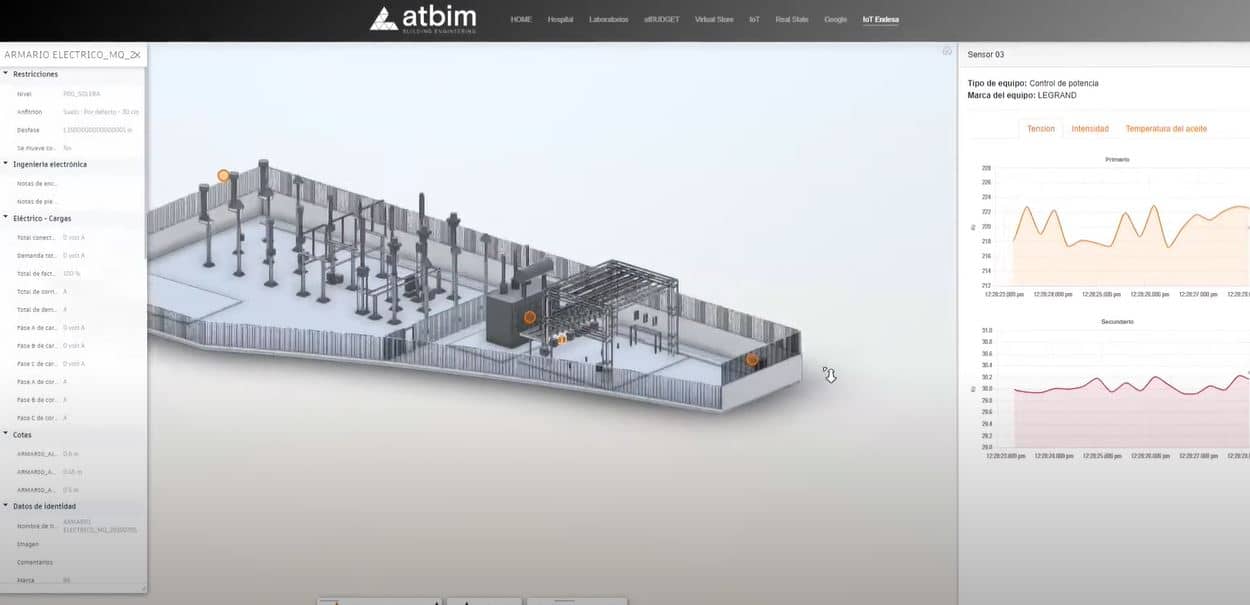
Ultimately, we work with parameters and data that are transformed into digital models used to visualize the actual condition of the existing building, as well as its interventions and renovations. These models provide a reliable database for decision-making, allowing decisions to be made earlier based on a virtual model. They help avoid unnecessary on-site visits to the facility, provide a foundation for training workers and operators in daily processes and occupational health and safety, and ultimately serve as the basis for many other uses that rely on a virtual model, eventually leading to the digital twin.
Now, the brain we are creating for the building needs to be fed with real-time data in order to unlock the full value of these virtual models. And that data needs to be high quality. From this point onward, integration begins. There is still much to be done.
We will discuss digital twins and their benefits in greater detail in future posts, but here is some additional reading:
- https://developer.ibm.com/technologies/iot/articles/what-are-digital-twins/
- https://www.digitwins.org/?_ga=2.265708231.930882407.1609769598-1945815296.1609769598
Spread the word!!!