Energy efficiency analysis from Revit with Green Building Studio
WHAT IS GREEN BUILDING STUDIO?
Autodesk Green Building Studio is a cloud-based BIM tool that allows you to run simulations of building performance to optimize energy efficiency and work towards carbon neutrality from the beginning of the process.
WHAT CAN I USE IT FOR?
The main utilities of this tool are:
- Have greater control in defining the project configuration
- Evaluate and optimizer processes for greater energy efficiency
GREEN BUILDING STUDIO CONNECTION - REVIT
We connect Green Building Studio and Revit through a gbXML file that we export from the Revit model. This format has a structure based on walls, floors, ceilings, windows and rooms and is designed to transfer the properties of the project from one program to another.
Something that we must be clear about is that, in Revit, we carry out the modeling of the project, with its corresponding properties and parameters and in Green Building Studio, we carry out the study of the energy analysis.
Once we have imported and loaded our gbXML file, the first thing the program will give us will be a default energy analysis with the data and properties that it has exported from the model.
It not only gives us economic data, but also energy data, as shown in the following images:
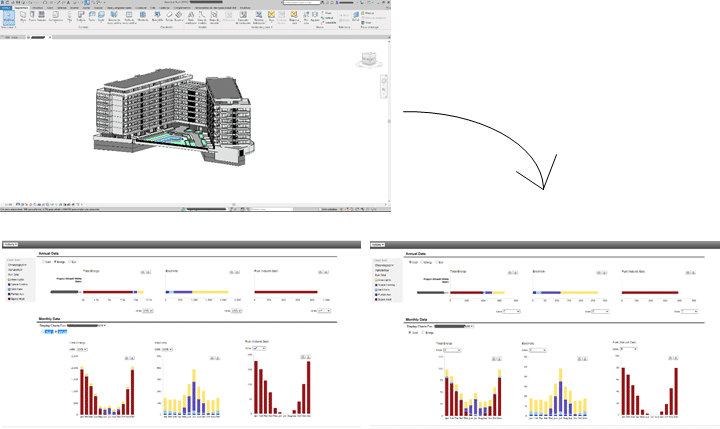
Our objective has to be perform an alternative improvement to the default analysis generated by modifying
- The composition of the facade according to the orientation,
- The composition of the roof, the electrical installation,
- The type of carpentry.
- HVAC installation
- Etc.
We have to take into account that this alternative can reduce or increase energy consumption.
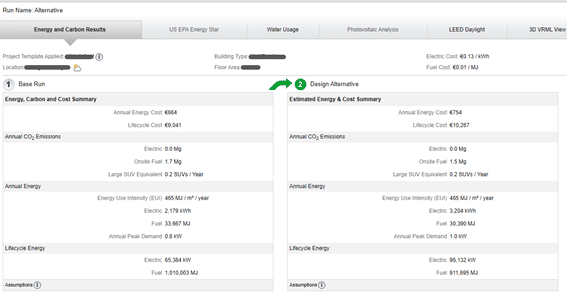
1
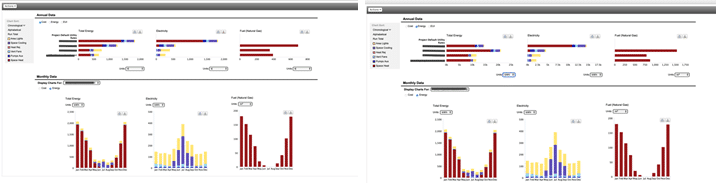
We can not only visualize this alternative in the form of numbers, but also through graphics.
2
In this case we can see that the different alternatives that we have proposed are not better than those that have been established in the project.
The purpose of carrying out an energy analysis is to improve the performance of the building during its useful life by improving acoustic and thermal comfort, reducing carbon emissions and reducing energy and economic costs.