BIM on Site: Uses, benefits and BIM maturity
The application of the BIM methodology is already an increasingly established reality in the design and drafting phase of architectural projects. Software such as Revit for architectural design and Tekla Structures or AllPlan for the calculation/design of structures are, today, daily work tools in the offices of many designers.
However, the jump to these BIM workflows, where the implementation of this methodology can provide even greater benefits, is currently, to say the least, asymmetric or unequal.
BIM uses on site
When we think about what BIM Uses can be useful for a contracting company, it is common for the order of priorities to make us imagine the following:
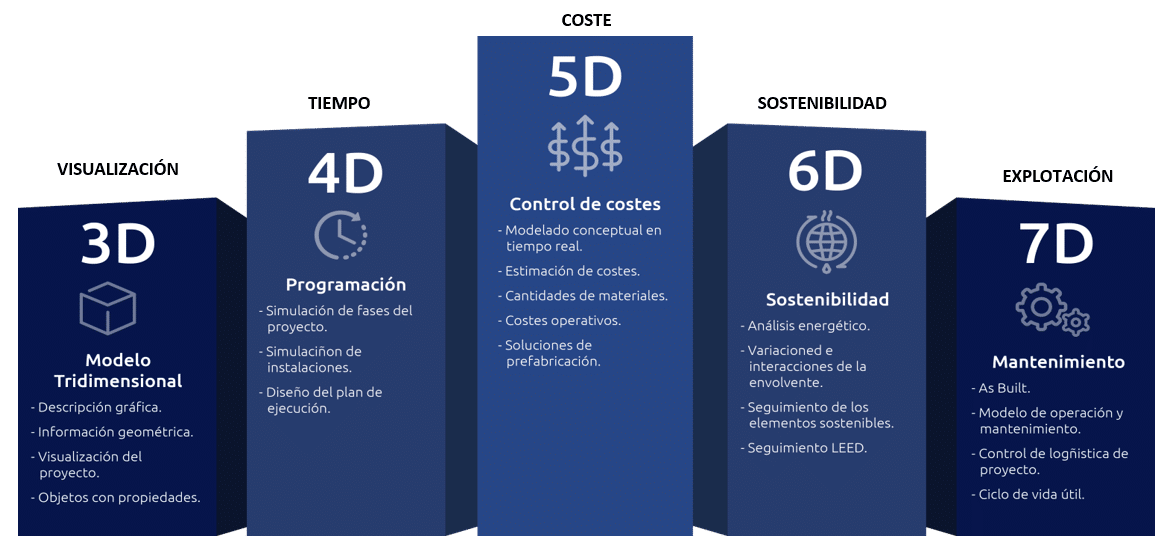
This image is a simplification of BIM uses reflected in what has come to be called: "the dimensions of BIM". Within these classifications, we see how 5D, or cost estimation, represents the use that arouses the greatest interest among contracting companies.
This is understandable, since controlling measurements and project costs is what can help us most to improve the profitability of a project, which is the basis of the business model of a construction company.
BIM maturity level
However, wanting is not always being able, and if we look at some surveys that have been developed to measure the level of BIM maturity, we find that the reality is quite different.
One of the best known is the Ranking published by the University of Pennsylvania on the most applied uses in the AEC (Architecture, Engineering and Construction) sector, where we have to go down to position 14 to find the use of "Cost estimation".
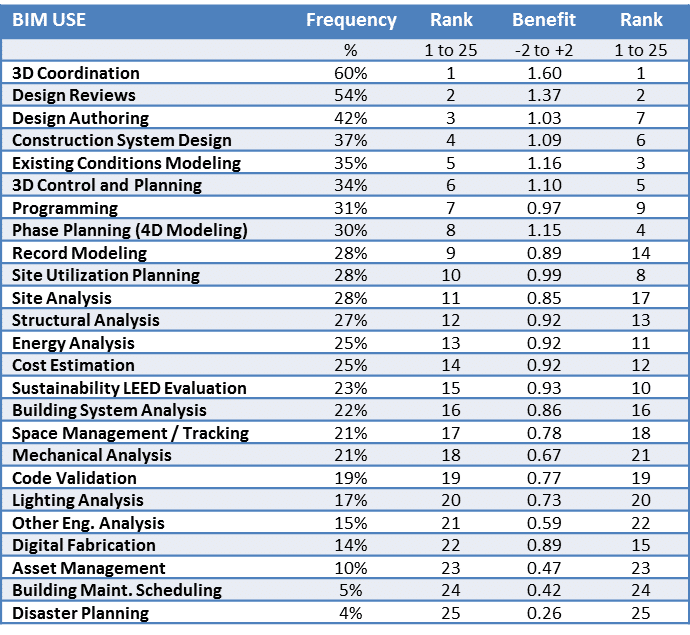
This is fundamentally due to the level of BIM maturity in which these projects are developed; What does this mean? Well, if the BIM level of maturity in our environment is low, the general quality of the models' information will be low, as will their reliability.
The uses to be applied must be chosen that are affordable at the BIM maturity level
A not very high level of information quality in a model already allows us, for example, to perform 3D coordination; since at least all the elements included in the models will have to have a defined Z dimension and approximate dimensions.
It also allows us to develop the design, from [the conceptual part] (https://atbim.com/como-usar-bim-concepto-edificios/) to the development of very defined executive projects, where part of the information can be transmitted as complementary information and not all of it will be directly linked to the BIM models.
Also, from a "simple" BIM model, planning management can be carried out in an easy and accessible way, which by linking our works plan with the elements of the model allows us to simulate, study and improve the execution program.
However, and as we mentioned previously, although cost estimation and control may be one of the uses that provide the most benefit to a construction company, a model of high quality and reliability is needed for its results to be useful.**
The key: improve the quality of the information contained in the models
At ATBIM, we work on the quality of the information in our models, and by carrying out periodic audits, we control that the models meet the necessary characteristics to be able to use them for uses such as cost estimation.
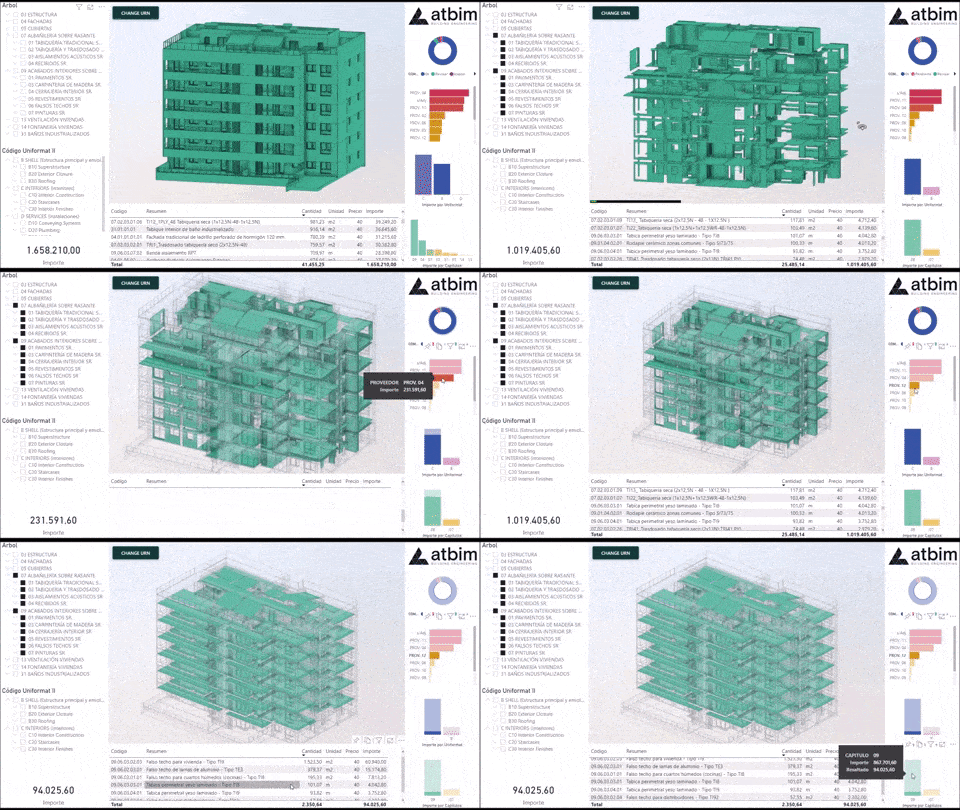
Also, we are working on the development of tools that simplify this process (below you can see an animated image of one of our tools in development) and allow us to approach a level of BIM Maturity where more and more uses, and more beneficial, can be applied in all works.