BIM on Construction Sites: Uses, Benefits and BIM Maturity
The application of BIM methodology is already an increasingly established reality in the design and architectural project development phases. Software such as Revit for architectural design and Tekla Structures or AllPlan for structural analysis and design are now everyday working tools in the offices of many designers.
However, the transition of these BIM workflows to the construction site, where the implementation of this methodology can provide even greater benefits, is currently, to say the least, asymmetric or uneven.
BIM uses on construction sites
When we consider which BIM Uses may be useful for a construction company, the usual order of priorities may lead us to imagine something like the following:
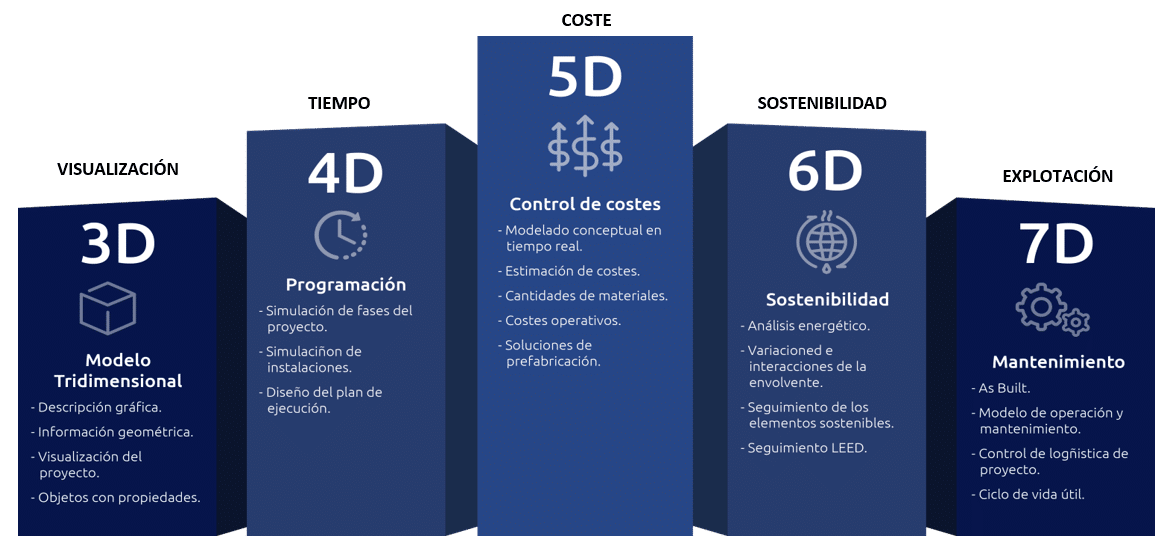
This image is a simplified representation of the BIM uses reflected in what has come to be known as the "dimensions of BIM". Within these classifications, we can see how 5D, or cost estimation, represents the use that generates the greatest interest among construction companies.
This is understandable, since controlling project quantities and costs is one of the factors that can contribute most to improving the profitability of a construction project, which is the foundation of a construction company’s business model.
BIM maturity level
However, wanting to do something does not always mean being able to do it, and if we look at some of the surveys conducted to measure BIM maturity levels, we find that the reality is quite different.
One of the best known is the ranking published by Pennsylvania State University on the most widely applied BIM uses in the AEC (Architecture, Engineering and Construction) industry, where we have to go down to 14th place to find "Cost Estimation".
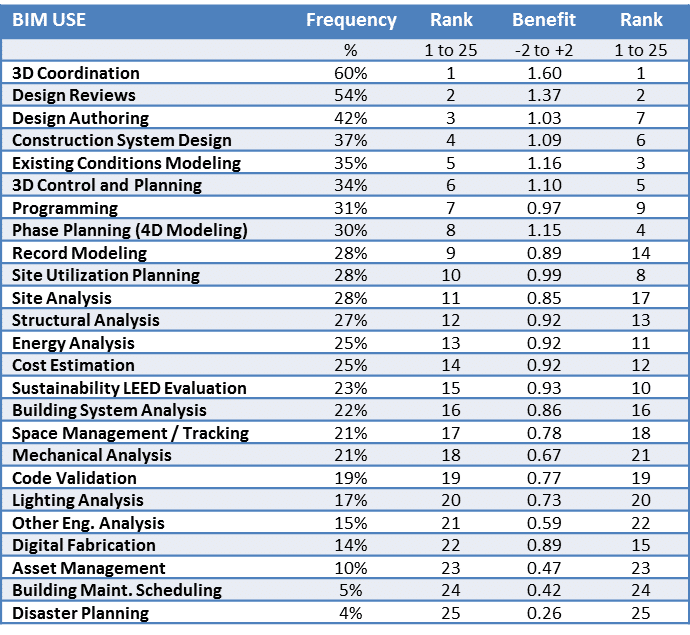
This is mainly due to the BIM maturity level at which these projects are developed. What does this mean? It means that if the BIM maturity level in our environment is low, the overall quality of the information contained in the models will also be low, as will its reliability.
The BIM uses to be implemented should be selected according to the achievable BIM maturity level
Even a model with a relatively low level of information quality already allows us, for example, to perform 3D coordination, since at the very least all elements included in the models must have a defined Z coordinate and approximate dimensions.
It also allows us to carry out design development, from the conceptual stage through to highly detailed construction projects, where part of the information can be provided as supplementary information rather than being directly linked to the BIM models.
A relatively "simple" BIM model can also be used easily and effectively for construction planning management. By linking our construction schedule to the model elements, we can simulate, analyze and improve the execution program.
However, as mentioned above, although cost estimation and cost control may be among the BIM uses that provide the greatest benefits to a construction company, a high-quality and reliable model is required for the results to be useful.
The key: improving the quality of the information contained in the models
At ATBIM, we work to ensure the quality of the information contained in our models, and through periodic audits, we verify that the models meet the requirements necessary to use them for purposes such as cost estimation.
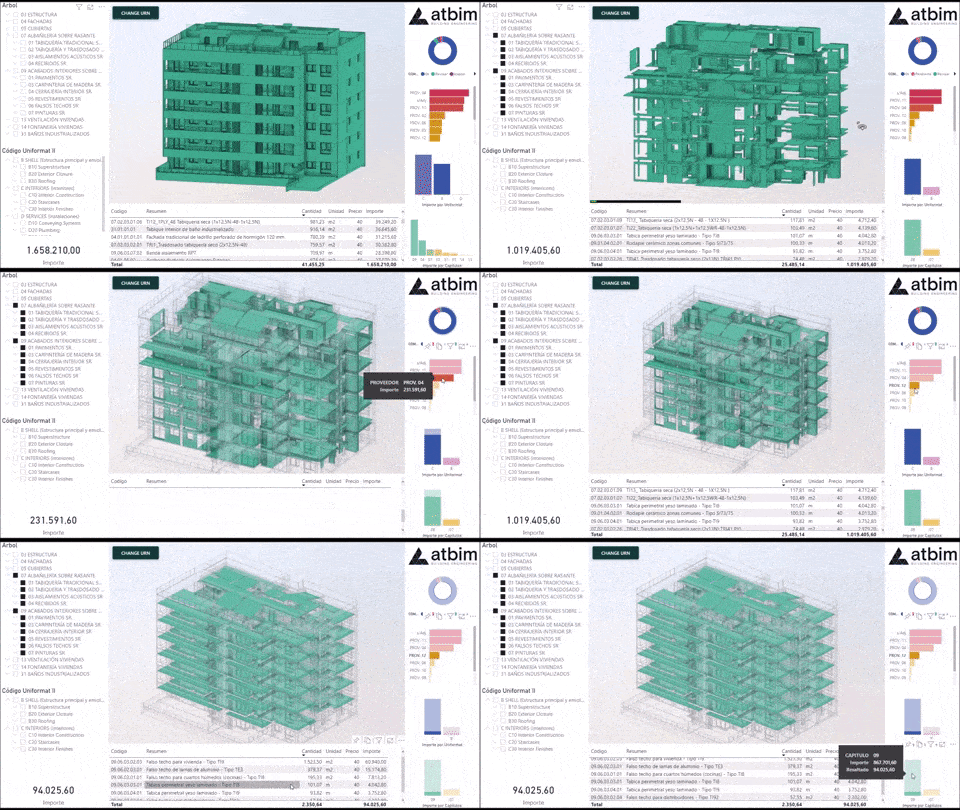
We also work on developing tools that simplify this process (below you can see an animated image of one of our tools currently under development) and help us move towards a higher level of BIM maturity, where an increasing number of BIM uses, including those that provide the greatest benefits, can be implemented across construction projects.