5 Key Points Showing How ISO 19650 Expands the Scope of BIM
One of the most important conclusions we can draw after exploring this first part of the standard is that “BIM is growing up.” At least, that is what we can conclude from the five key points analyzed below.
1. BIM maturity
The publication of an ISO standard further consolidates the idea that BIM is here to stay, in case anyone still had doubts. This represents an advance at a technical level, but also at a strategic level, where it is increasingly difficult to justify any progress within the industry that does not involve integration into the BIM methodology.
2. Scalability
In this case, rather than saying that “BIM is growing up,” we could also say that BIM is becoming smaller. One of the most noteworthy principles of the standard challenges the pseudo-slogan or justification that “BIM is only for large projects.”
BIM is suitable for all types of projects. The introduction to the document itself states that the standard applies to built assets and construction projects of any size and level of complexity.
Obviously, not all projects are the same, and their structure is determined by their size and level of complexity. This is why the concept of scalability is emphasized: it should be applied proportionally and adapted to the scale and complexity of the project.
Today, BIM is already a reality in virtually all megaprojects. However, the benefits of applying BIM methodology could be considered proportionally even greater in “Little BIM” projects, where ensuring control over its implementation is often easier. In any case, the team structure, requirements and objectives must be adapted to the characteristics of the project.
3. For everyone
Another reason why we believe BIM “grows” under this standard is the wide range of roles and stakeholders identified as its intended audience.
“The concepts and principles of this document are aimed at everyone involved in the life cycle of assets. This includes, but is not limited to, the asset owner/operator, client, asset manager, design team, construction team, equipment manufacturer, technical specialist, regulator, investor or end user.”
In other words, the standard emphasizes the cross-functional nature of information management within a project. This is particularly important for understanding that BIM methodology and the management of its associated information must involve all departments within an organization rather than remaining isolated or operating in parallel. BIM models, for example, are information containers that departments such as finance, legal or administration may also need to access in order to consult information related to their responsibilities.
4. Throughout the entire life cycle
Another concept expanded by the standard is the scope of its application throughout the asset life cycle.
In the main document defining information requirements, the EIR (Exchange Information Requirements), both Project Information Requirements (PIR) and Asset Information Requirements (AIR) must be considered.
“This document applies to the entire life cycle of any built asset, including strategic planning, initial design, engineering, development, documentation and construction.”
As shown in the following diagram, the project delivery phase represents only a relatively small part of information management compared with the operational phase. Particular emphasis is placed on transition stages A and C, where relevant information is transferred between the project and the asset.
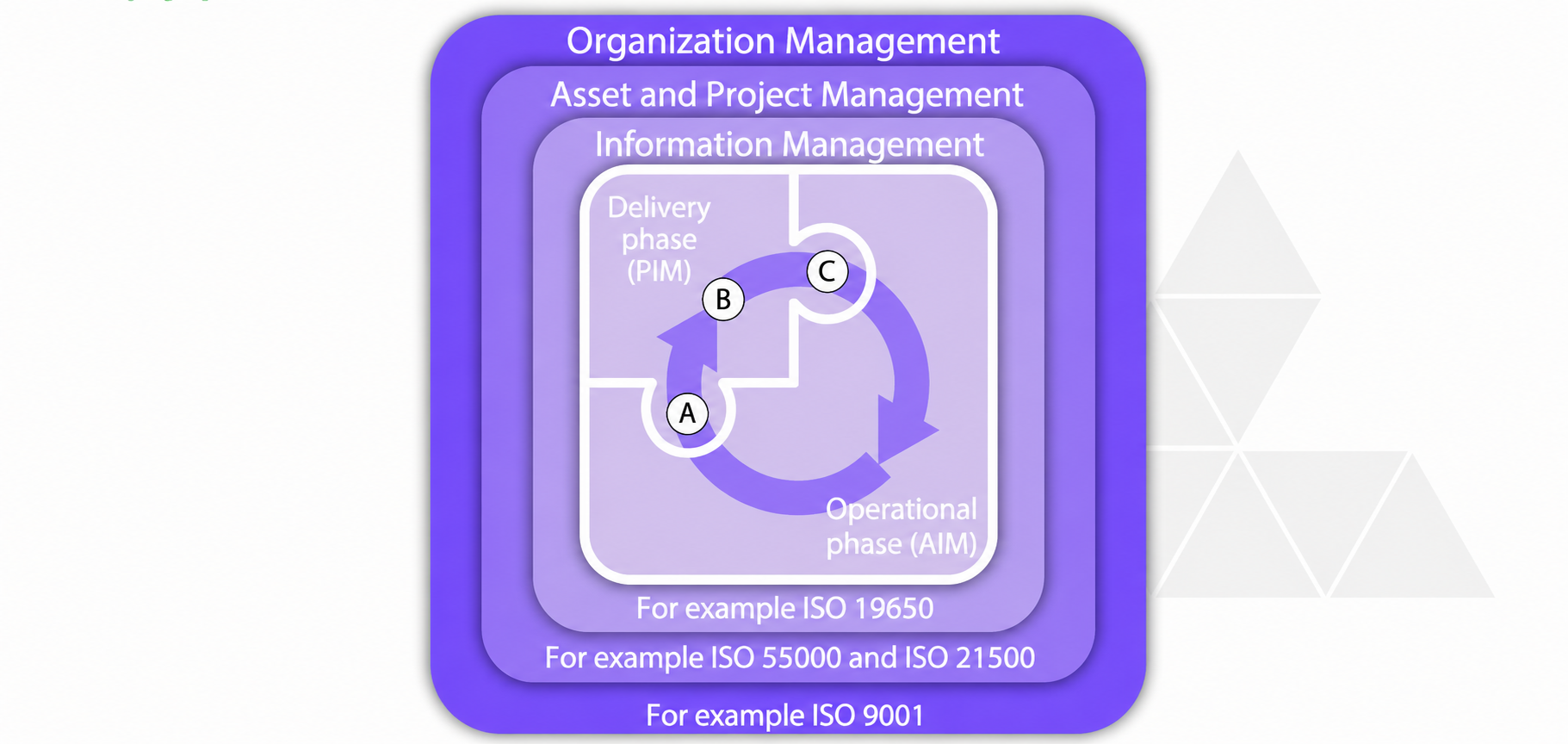
Legend: A — Start of the delivery phase: transfer of relevant information from the AIM to the PIM. B — Progressive development of the initial design model into the virtual construction model. C — End of the delivery phase: transfer of relevant information from the PIM to the AIM. Simplified extract from the diagram in UNE-EN ISO 19650-1. These transition stages A and C are key points in the process.
The first stage, A, would in most cases coincide with the development of the building project, where existing asset information—such as information about a building to be demolished, the site or an existing building to be renovated—is extracted and used throughout the project.
Stage C corresponds to the transfer of information from the project delivery phase into the building’s operational phase, which would coincide with the delivery of information and/or As-Built models.
It is important to highlight the scalable nature of this cycle, which can be applied to any intervention involving an asset, regardless of its current state.
5. All the information
This is not a new concept. Both the title of the standard, “Organization and digitization of information (...)”, and the BIM acronym itself place information at the heart of the entire process.
Information management is once again one of the main aspects of the standard, and its organization within the CDE (Common Data Environment) is one of the pillars already established by PAS 1192 and maintained within ISO 19650.
[caption id="attachment_1371" align="aligncenter" width="750"]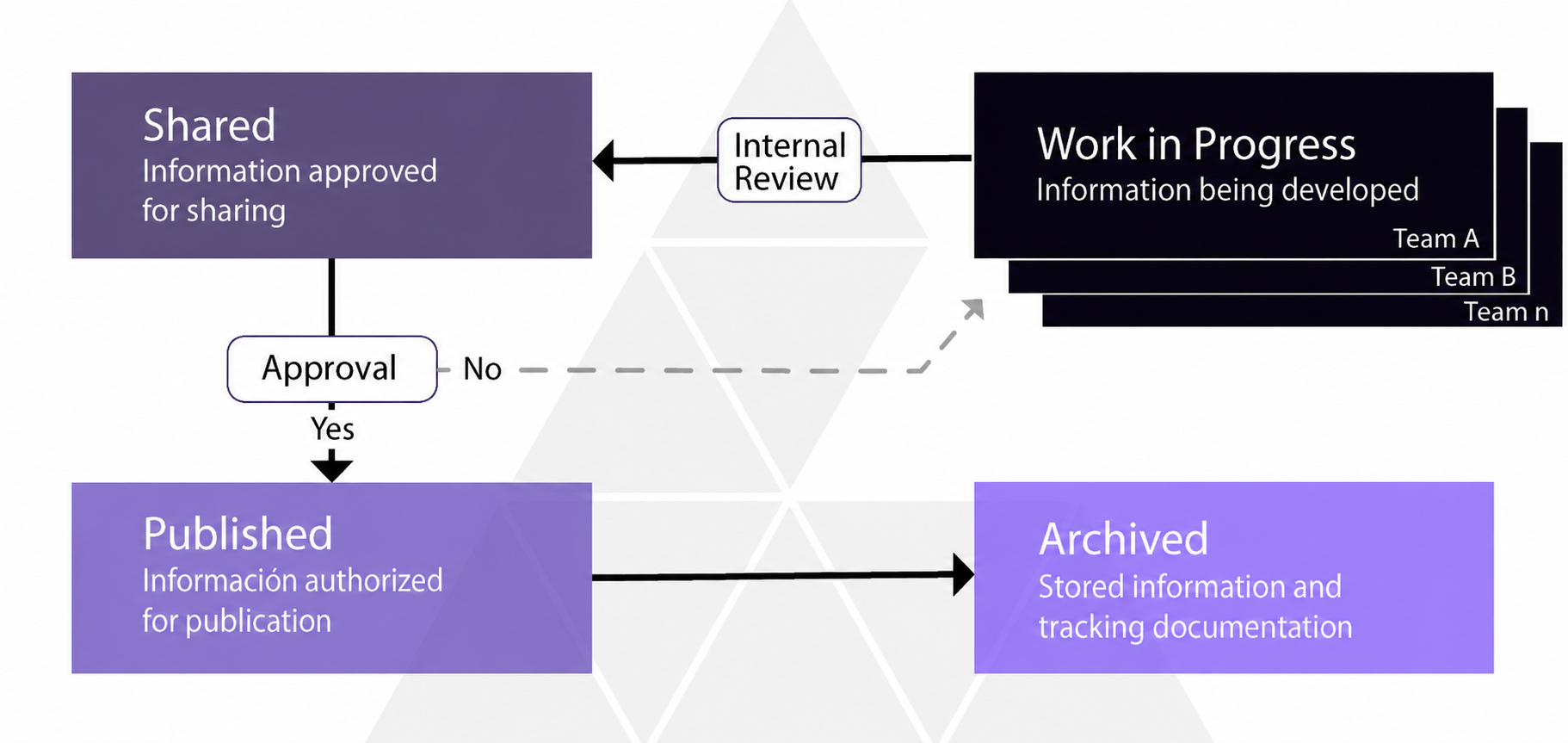 Simplified diagram of the Common Data Environment (CDE) proposed by UNE-EN ISO 19650-1[/caption]
One concept regarding information that we found particularly interesting is the introduction of information granularity.
This concept of granularity emphasizes that the information provided should be the minimum necessary to satisfy each requirement. In other words, providing more information than necessary does not necessarily help achieve the intended objective; instead, it can make it more difficult to correctly use the information that is actually required.
The standard even emphasizes its importance by stating: “The granularity of alphanumeric information should be considered at least as important as the granularity of geometric information.”
Therefore, the level of definition and/or development of information should always be determined by the objectives that need to be achieved.
We can therefore conclude that, for BIM development, the most important principle is:
The right information, in the right place, at the right time.
Finally, in our next article, we share a diagram that provides an overall view of the concepts introduced in the second part of the ISO 19650 BIM standard.